If you’ve ever visited a manufacturing floor that produces PVC pipes—whether for plumbing, irrigation, or industrial piping—you’ve probably seen a long, continuous line of pipe being pulled slowly, steadily, from an extruder. What you might not have noticed is the quiet workhorse making that constant pull possible: the haul-off unit. As a PVC pipe machine supplier with decades of on-the-ground experience troubleshooting and upgrading extrusion lines, I can’t tell you how many times new buyers or even plant managers overlook this component, assuming it’s just a “set-it-and-forget-it” afterthought. But the haul-off unit isn’t just a puller—it’s the part that turns a messy, molten extrudate into a consistent, usable pipe, and its performance directly dictates the quality, speed, and profitability of your entire production run. PVC Pipe Machine
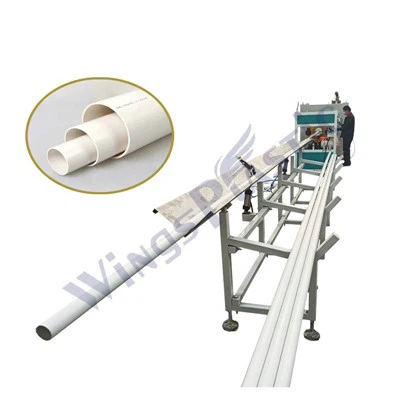
Let’s start with the basics of how a PVC pipe extrusion line works, to set the stage. The process kicks off with raw PVC resin, mixed with stabilizers, plasticizers, and colorants, melted and compressed in an extruder’s barrel. A shaped die at the extruder’s end forms the molten plastic into a hollow pipe profile, which is immediately cooled in a vacuum calibration tank to hold its shape. Up to that point, the pipe is still soft, semi-molten, and held together only by the strength of the plastic at that temperature. Without the haul-off unit right after the calibration tank, the pipe would just droop, stretch unevenly, or even collapse under its own weight—especially for larger-diameter pipes. That’s where the haul-off steps in: its core job is to provide controlled, continuous tension to pull the calibrated pipe away from the cooling tank at a precise, steady speed, matching the speed of the extruder and calibration system to maintain consistency.
But that description barely scratches the surface. For a PVC pipe haul-off isn’t just a pair of rollers pulling material; it’s a system designed to solve specific challenges unique to PVC, a material that’s rigid when cool but extremely sensitive to heat, prone to warping, stretching, or surface defects if pulled unevenly. Let’s break down its key roles, one by one, because each ties directly to the end product and your bottom line.
First, uniform speed synchronization across the entire line. This is non-negotiable. If the haul-off runs faster than the extruder, you’ll get a thin, stretched pipe with inconsistent wall thickness; if it runs slower, the molten extrudate will pile up at the die, causing bulges, uneven diameters, or even material jams that stop production entirely. A good haul-off unit uses a closed-loop drive system, usually a servomotor or variable frequency drive (VFD), that ties its speed directly to the extruder’s output. Many of our customers forget that not all haul-offs offer this: cheaper models run on fixed speed, which forces operators to manually adjust extruder settings to match, a process that wastes time and leads to frequent quality rejects. For example, a customer of ours was running 200mm PVC irrigation pipes on a low-budget line, and their wall thickness was varying by up to 15%—enough to fail industry standards. We upgraded their haul-off to a servo-driven model with line speed feedback, and wall thickness variation dropped to less than 3%, cutting their reject rate by 80% overnight. That’s the kind of impact a properly integrated haul-off makes.
Second, controlling dimensional accuracy and uniformity. PVC pipes are sold by their outer diameter (OD) and wall thickness, and even small deviations can lead to entire batches being rejected or failing pressure tests. The haul-off’s rollers or belts work with the calibration tank to maintain consistent tension along the pipe’s length. If tension is too high, the pipe will stretch, reducing wall thickness; too low, and the pipe can “sag” between the haul-off’s pull points, causing a temporary increase in wall thickness. Modern haul-offs use a dual-side belt system (rather than just top rollers) to distribute pressure evenly around the pipe’s circumference, eliminating uneven compression. We also build our haul-offs with adjustable roller pressure, so operators can fine-tune tension based on pipe size: smaller 15mm PVC electrical conduit needs lighter pressure to avoid deforming its thin wall, while 400mm PVC sewer pipe requires higher, consistent tension to keep its large diameter round. Without this, even a perfect die and calibration tank can produce pipes that don’t fit into standard fittings, leading to costly rework or lost sales.
Third, surface quality and cosmetic finish. PVC pipe buyers—whether residential plumbers or industrial construction companies—expect a smooth, blemish-free surface. The haul-off’s contact with the pipe is a big factor here. Old, worn haul-off rollers with rough surfaces can scratch the soft, newly cooled PVC, leaving marks that compromise the pipe’s structural integrity or make it unmarketable. That’s why our haul-offs use precision-ground rubber-coated belts or rollers, with a specific durometer (hardness) rated for PVC: too soft, and the belt will slip, causing speed variations; too hard, and it will mar the surface. Another issue is pipe twist, a common defect where the pipe’s cross-section rotates unevenly along its length. This happens when the haul-off’s pull is not centered or balanced, twisting the pipe as it’s pulled. We’ve seen this defect blamed on extruder dies or calibration tanks, but 30% of the time it’s a misaligned haul-off. Our design includes a self-centering guide system that keeps the pipe perfectly straight as it’s pulled, eliminating twist and ensuring a uniform finish every time.
Fourth, handling different pipe profiles and sizes. PVC pipe lines don’t just make one size of pipe—many shops run a range from 10mm small conduit to 600mm large sewer pipe. A versatile haul-off is critical here, because adjusting to new pipe sizes quickly minimizes changeover time, which directly affects production throughput. Cheaper haul-offs require manual repositioning of rollers, which can take 30 minutes or more to swap between sizes, slowing down jobs. Our haul-offs feature quick-change, motorized adjustment for roller spacing and pressure, so operators can switch between a 50mm pressure pipe and a 200mm irrigation pipe in under 5 minutes. We also build haul-offs with modular options, so if a customer later expands their line to include larger diameter pipes, they can upgrade the haul-off without replacing the entire unit. This flexibility is especially important for small to mid-sized manufacturers who don’t have the budget to invest in a new line every time they add a product.
Fifth, supporting high-speed production without sacrificing quality. As extrusion technology has improved, extruders now run at much faster speeds than they did 20 years ago—some lines can produce PVC pipe at over 10 meters per minute, compared to 2 meters per minute in the 1990s. The haul-off has had to keep pace, because pulling a long pipe at high speed requires consistent, reliable power. Low-quality haul-offs can’t maintain steady speed at high rates, leading to sudden stops or speed spikes that cause wall thickness variations or pipe breaks. Our haul-offs are built with heavy-duty gearboxes and reinforced frames, designed to handle the torque needed for high-speed, continuous pull, with sensors that detect even minor speed changes and adjust automatically. One of our customers, a large irrigation pipe manufacturer, upgraded their haul-off alongside a new high-speed extruder, and their production output increased by 45%—all while reducing reject rates because the haul-off could keep up with the faster line speed.
Now, let’s talk about common mistakes we see buyers make when choosing a haul-off unit. First, prioritizing low cost over performance. It’s tempting to save money on a cheap haul-off, but in the long run, the downtime, reject rate, and lost productivity will far outweigh the initial savings. We had a customer who bought a line with a $10,000 cheap haul-off, thinking he saved $5,000, but within six months, he was spending $1,500 per month on repairs and had a 12% reject rate. After upgrading to our haul-off, his repair costs dropped to $200 per month, and his reject rate fell to 2%, saving him over $15,000 a year. Second, ignoring integration with other line components. A haul-off only works well if it’s synced with the extruder, calibration tank, and cutting machine. We always advise customers to choose a haul-off that’s designed to work with the rest of the line, not just a generic unit. For example, if you’re using a vacuum calibration tank with a specific exit speed, a haul-off with closed-loop speed control will automatically adjust to match that, rather than requiring manual tweaking. Third, neglecting maintenance. Even the best haul-off needs regular upkeep: cleaning the rollers, checking belt tension, and calibrating the speed sensors. We provide a detailed maintenance guide for every unit we sell, and offer on-site training to plant managers, because a poorly maintained haul-off will degrade in performance over time, leading to quality issues.
So, what does this mean for you, as someone running a PVC pipe manufacturing operation? The haul-off unit isn’t an afterthought—it’s a core component that impacts every part of your production: speed, quality, cost, and flexibility. Whether you’re a small shop making electrical conduit or a large plant producing industrial sewer pipe, investing in a high-quality haul-off isn’t just a nice upgrade; it’s a way to improve your bottom line and stay competitive.
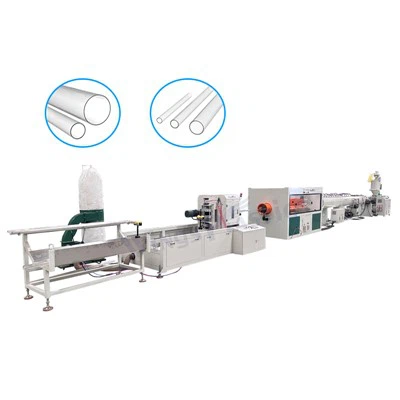
If you’re looking to upgrade your current line, or are in the market for a new PVC pipe machine, don’t overlook the haul-off unit. We’ve helped hundreds of customers optimize their lines by choosing the right haul-off for their specific needs, and would be happy to walk you through the options, answer your questions, and help you find a solution that fits your production goals.
PPR Pipe Machine References:
- Rosato, D. V., & Rosato, D. V. (2012. Extrusion Control Systems for Thermoplastics. Carl Hanser Verlag.
- Giles, G. A., & Wagner, J. R. (2014. Extrusion: The Definitive Processing Guide and Handbook. William Andrew Publishing.
- American Society for Testing and Materials. (2018. Standard Specification for Poly(Vinyl Chloride) (PVC) Plastic Pipe, Schedules 40, 80, and 120. ASTM D1785.
- Plastics Technology Institute. (2020. PVC Extrusion Process Optimization. PTI Technical Bulletin No. 47.
Qingdao Wings Plastic Technology Co., Ltd.
As one of the most experienced pvc pipe machine manufacturers and suppliers in China, we also support customized service. Please feel free to buy durable pvc pipe machine made in China here from our factory. For price consultation, contact us.
Address: C02 Of Anshengyi Road, No.2 Fuan Industry Zone,Jiaodong Town, Jiaozhou City, Qingdao City, Shandong Province,China
E-mail: kelly@wingsplastic.com
WebSite: https://www.wingsextruder.com/
